
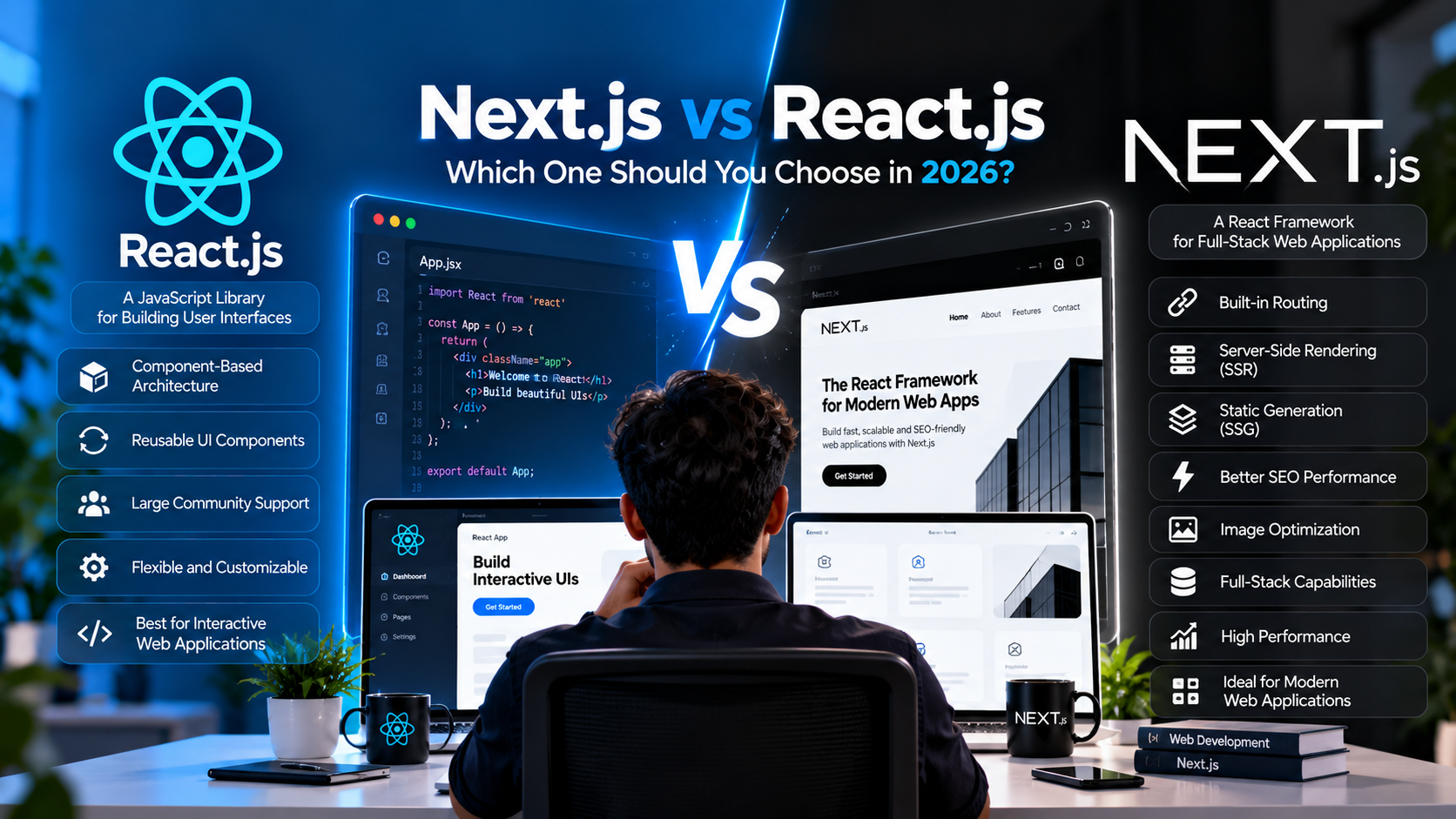
React.js is a JavaScript library focused primarily on building user interfaces, while Next.js is a React framework that provides additional capabilities such as routing, rendering strategies, data fetching, caching, and full-stack application features.
But which one should you choose in 2026?
The answer depends on the type of application you are building, your SEO requirements, performance goals, development workflow, and how much control you want over your application architecture.
What Is React.js?
React.js is an open-source JavaScript library for building interactive user interfaces.
React allows developers to create reusable components and combine them to build modern web applications. Its component-based architecture makes it easier to organize and maintain large user interfaces.
React intentionally focuses on the UI layer, which means developers can choose additional tools for routing, data fetching, state management, styling, and other application requirements.
The React documentation describes React as a library for building user interfaces, while leaving other application decisions to the developer.
Key Features of React.js
Component-based architecture
Reusable UI components
Large developer ecosystem
Strong community support
Flexible application architecture
Rich ecosystem of third-party libraries
Excellent support for interactive applications
React is commonly used for dashboards, admin panels, SaaS applications, interactive websites, and single-page applications.
What Is Next.js?
Next.js is a React framework designed for building modern web applications.
Instead of requiring developers to select and configure many separate tools, Next.js provides many application-level capabilities as part of the framework.
These include routing, rendering, data fetching, caching, and other features needed for production web applications.
Next.js currently supports both the App Router and the older Pages Router, with the App Router being the newer architecture designed around modern React features such as Server Components.
Key Features of Next.js
File-system based routing
Server Components
Client Components
Server-side rendering
Static generation
Dynamic rendering
Data fetching
Caching
Image optimization
Full-stack application capabilities
Built-in performance features
Next.js can therefore be useful when a project needs more than just a UI library.
React.js vs Next.js: Main Difference
The simplest way to understand the difference is:
React.js = UI library
Next.js = React framework for building complete web applications
React gives developers flexibility to choose the tools they need.
Next.js provides a more structured development environment with many features already integrated.
For example, a React project may require separate libraries or configuration for routing and other application concerns. Next.js provides many of these capabilities through the framework itself.
Performance depends on how an application is designed, not simply on whether it uses React or Next.js.
React can be extremely fast when components, rendering, state management, code splitting, and assets are properly optimized.
Next.js provides additional tools and rendering strategies that can help developers build performant applications. Its App Router uses Server Components by default, allowing developers to keep some UI and data-fetching work on the server and send less client-side JavaScript where appropriate.
Next.js 16.x has also introduced improvements around development performance, rendering, navigation, and Turbopack.
However, developers should still optimize images, JavaScript bundles, database queries, APIs, and third-party scripts.